Commercial Heat Pump Design Assurance Review
Independent technical review of proposed commercial heat pump designs before installation, procurement or site changes become expensive to correct.
Reduce avoidable design risk before the system reaches site.
Many commercial heat pump issues are locked into the project before commissioning starts. A Design Assurance Review checks whether the heat pump has the right system conditions around it before installation, procurement or client commitment becomes difficult to reverse.
The review focuses on the practical details that often affect real-world performance: hydraulic arrangements, buffer volume, low loss headers, controls, sequencing, BMS visibility, operating temperatures, flow rates and maintainability.
This is not a full redesign service. It is a focused independent review that highlights technical risks, practical concerns and areas requiring clarification before they become costly site issues.
We typically review
- Plant schematics and hydraulic arrangements
- Buffer tanks, volumisers and low loss headers
- Heat pump flow and return positions
- Primary and secondary pump arrangements
- System volume and minimum runtime strategy
- Controls philosophy and sequencing
- Duty/standby, duty/assist and lead/lag arrangements
- BMS points, trend data and alarm visibility
- Defrost, anti-cycle and protection considerations
- Commissioning and operational risk areas
Small design decisions can create large operational problems.
Heat pump performance depends on the system around it. The earlier risks are identified, the easier they are to resolve.
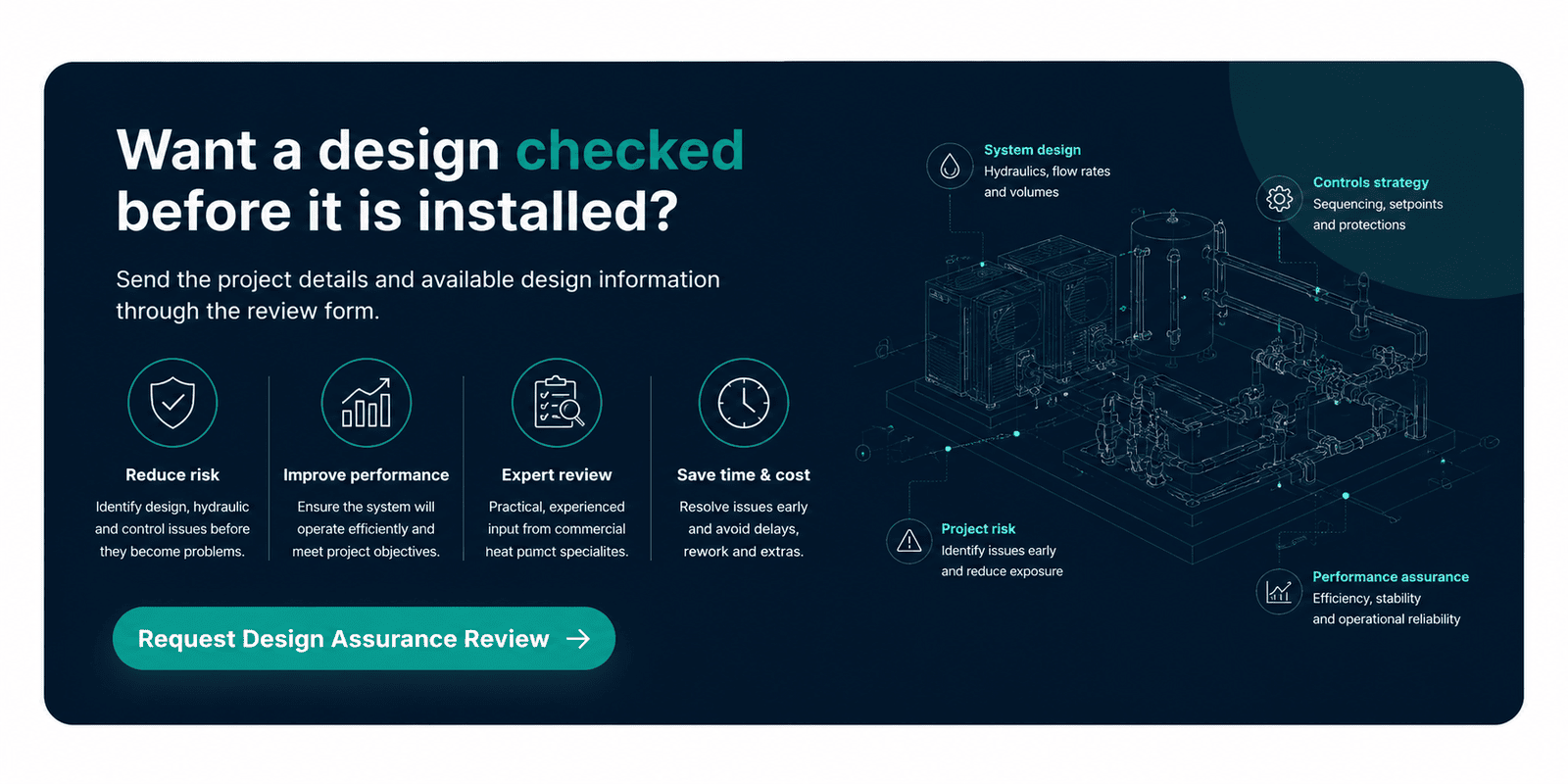
Reduce risk
Identify design, hydraulic and control issues before they become site problems.
Improve performance
Check whether the system is likely to support stable and efficient heat pump operation.
Protect programme
Highlight issues before installation, commissioning or client handover.
Support decisions
Give clients and project teams clear technical observations before committing.
Common issues found during review
- Insufficient system volume for stable operation
- Buffer or volumiser location not supporting the intended outcome
- Low loss header arrangements likely to create unwanted mixing
- Primary and secondary flows not aligned with design intent
- Controls strategy relying on assumptions rather than defined logic
- Unclear heat pump staging, lead/lag or duty/standby operation
- Missing BMS points needed for useful trend analysis
- No clear visibility of compressor starts, runtime, faults or modes
- Defrost and low-load operation not properly considered
What the review is designed to achieve.
The purpose of the review is to give the client and project team a clear view of the main technical risks before the system is installed or finalised.
Where issues are identified, the report explains why they may matter, what the likely operational impact could be, and what practical action should be considered.
The review can be used to support design workshops, project risk reviews, client approvals, contractor discussions and commissioning preparation.
Clear technical output, written for action.
The output is designed to be useful to building owners, estates teams, consultants, contractors and project stakeholders.
Risk observations
Key points that may affect performance, reliability, commissioning or operation.
Technical comments
Clear notes on hydraulic, controls, volume, BMS and system assurance issues.
Priority actions
Practical recommendations ranked by urgency, impact and design importance.
Client-ready report
Structured report suitable for review meetings and project team discussion.
Information normally required.
The more complete the information, the more useful the review can be. A review can still begin with limited information, but assumptions and limitations will be clearly stated.
Where information is missing, the review may identify what should be requested before the design is finalised.
Useful documents
- Plant schematics
- Equipment selections and datasheets
- Flow and return temperature schedules
- Design flow rates and pump information
- Buffer tank, volumiser or low loss header details
- Controls philosophy or sequence of operation
- BMS points list and monitoring requirements
- Commissioning or handover requirements
- Client operating requirements or known concerns