
Commercial Heat Pump System Health Check
For live commercial heat pump systems that are cycling, faulting, underperforming, struggling with temperature or failing to meet client expectations.
Find what is really causing poor performance.
When a commercial heat pump system is not working properly, the visible fault is rarely the whole problem. The Health Check reviews system behaviour, data, control logic, hydraulic conditions and site evidence to identify practical next steps.
The aim is to separate equipment issues from system issues, then give the client a clear route to improvement.
This is useful when a system is already live but the project team, building owner or estates team needs a clearer understanding of why the system is not performing as expected.
Common triggers
- Frequent faults and nuisance alarms
- Short cycling or excessive compressor starts
- Poor COP or high energy use
- Low delta T and poor heat transfer
- Heating, cooling or recovery mode interaction problems
- Defrost issues or poor winter performance
- Unclear BMS trends or limited system visibility
- Client confidence problems after handover
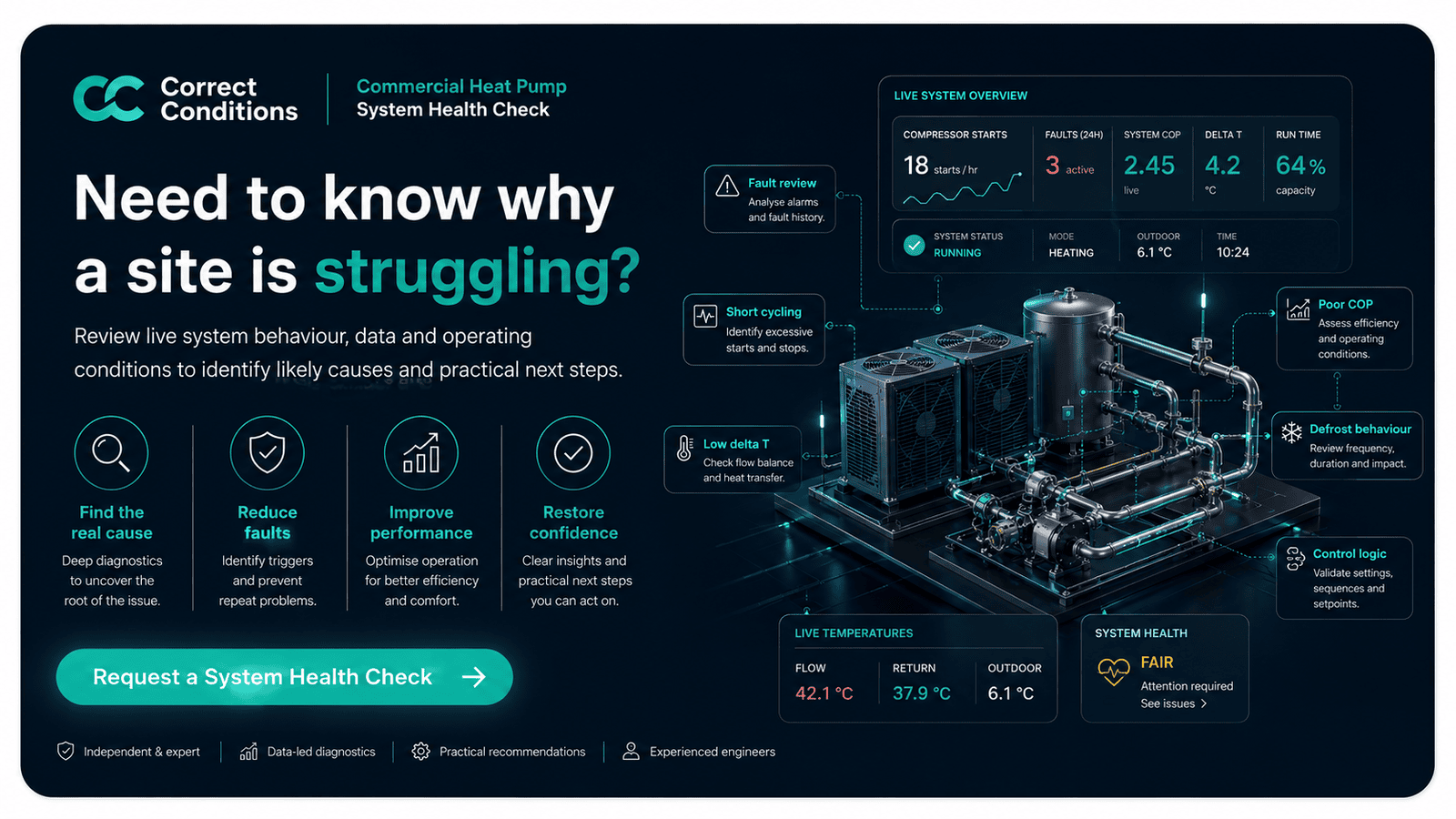
Evidence-led review of live system behaviour.
A Health Check uses available project information, site evidence and operating data to understand how the system is actually behaving.
Faults and alarms
Review repeated faults, nuisance alarms, reset patterns and fault history to identify recurring issues.
Runtime and starts
Check whether the system is achieving stable operating periods or cycling excessively.
Temperatures
Review flow, return, delta T and operating temperatures against the system requirement.
Controls behaviour
Review sequencing, setpoints, enable signals, pumps, modes and control logic where visible.
Hydraulics
Review buffer volume, low loss headers, flow paths, bypassing, mixing and flow balance risks.
COP and energy
Where data allows, assess whether performance indicators match expected operation.
Defrost behaviour
Review winter operation, defrost frequency, recovery and system impact where relevant.
Site conditions
Consider operational issues, user complaints, commissioning gaps and real site constraints.
Health Check stages
Information review
We review the available schematics, equipment selections, control descriptions, fault history and BMS or trend data.
System analysis
We analyse operating temperatures, starts, runtime, sequencing, alarms, flow behaviour and available performance indicators.
Recommendations
We provide clear findings and practical actions to reduce risk, improve performance and support the client’s next decision.
Separate equipment issues from system issues.
A heat pump fault does not always mean the heat pump is the root cause. Poor flow conditions, unsuitable controls, low system volume, poor sequencing, incorrect sensor locations or operating assumptions can all create symptoms that appear as equipment problems.
The Health Check is designed to look at the wider system and identify the most likely causes, rather than simply reacting to the latest alarm.
This helps clients avoid unnecessary blame, repeated resets, reactive callouts and changes that do not solve the real issue.
Useful information to provide
- Plant schematics
- Heat pump model numbers and selections
- Fault history and alarm logs
- BMS trend data
- Flow and return temperature data
- Runtime and compressor start data
- Control descriptions or BMS points list
- Commissioning records where available
- Client complaints or operational notes
Clear findings and practical next steps.
The output is designed to help the client and project team understand what is happening, what is likely causing the issue and what should be reviewed or actioned next.
Key findings
Clear summary of the main issues found from the information and data reviewed.
Likely causes
Practical explanation of whether the issue appears related to equipment, hydraulics, controls, data or operation.
Priority actions
Recommended next steps ranked by urgency, risk and likely impact.
Client-ready report
Structured report suitable for internal review, project meetings and decision making.
Need to understand why a site is struggling?
Start with a System Health Check request. We can review the available information and confirm the most appropriate route.