
PIP — Performance Improvement Programme
Ongoing monitoring, review and improvement support for commercial heat pump systems after the initial design review or system health check.
Improvement should be measured, not guessed.
PIP turns a one-off review into a structured improvement programme. The aim is to identify issues early, track whether actions are working, and provide evidence of system improvement over time.
Instead of relying on assumptions, PIP uses site data, operating trends and technical review to understand how the system is really performing.
The programme can review BMS trend data, fault history, flow and return temperatures, compressor starts, runtime, COP, seasonal performance indicators and operational feedback.
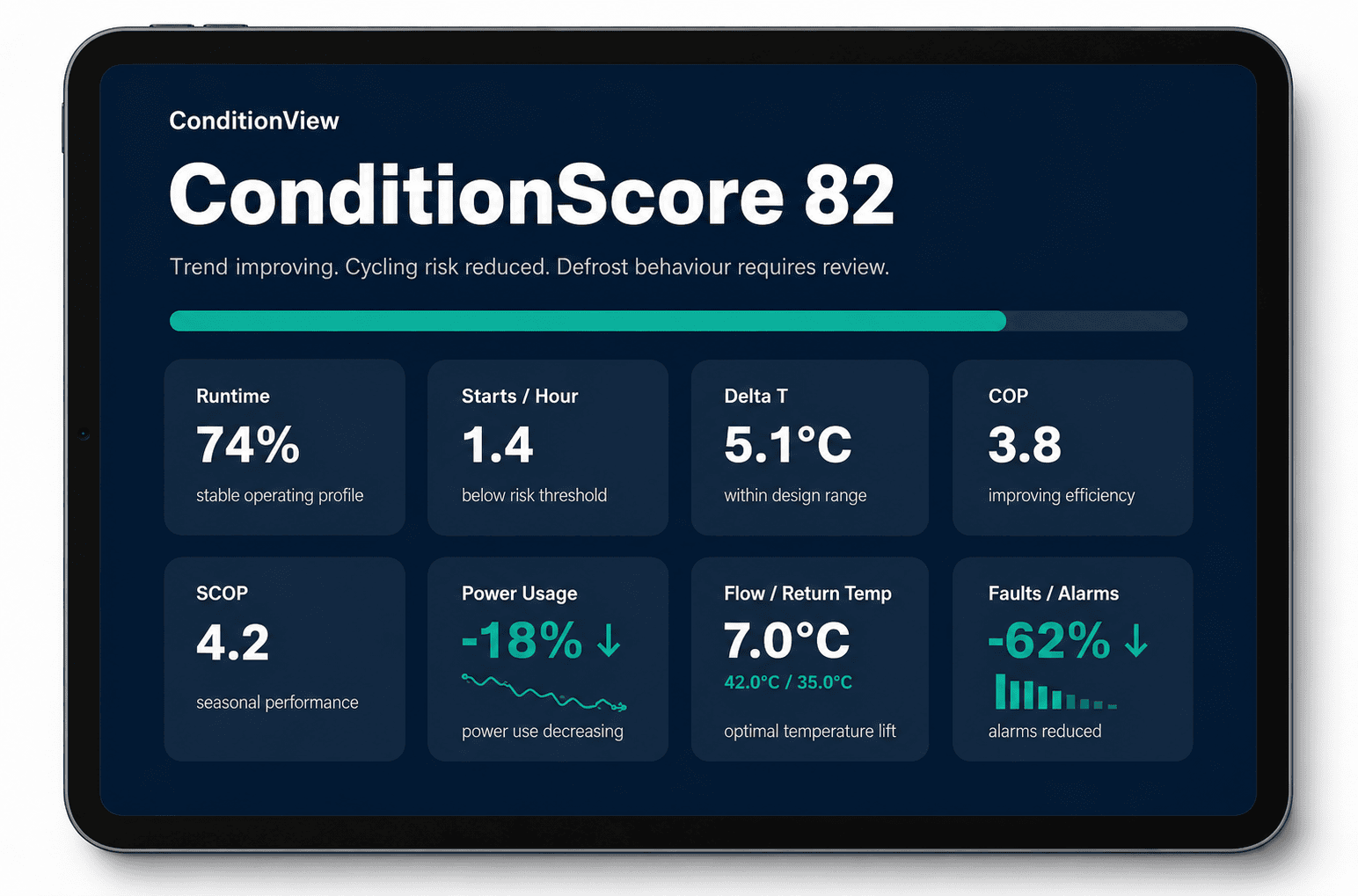
PIP measures what matters.
Commercial heat pump performance is affected by more than one number. PIP looks at the system conditions that influence reliability, efficiency and client confidence.
Runtime
Is the system getting stable operating periods, or is it repeatedly starting and stopping?
Starts
Are compressors starting too often, increasing wear and reducing operating stability?
Delta T
Is useful heat transfer taking place, or are flow rates and controls masking poor operation?
COP
Is the heat pump delivering useful heat efficiently under real operating conditions?
SCOP
Is seasonal performance improving across changing load and weather conditions?
Power usage
Is electrical consumption reducing as the system is improved, or are issues being hidden?
Faults and alarms
Are alarms repeating, being reset without investigation, or pointing to a wider issue?
Temperatures
Are flow, return and ambient conditions supporting efficient, reliable operation?
From one-off review to ongoing improvement.
A single review can identify the likely causes of poor performance, but improvement should continue after the first report. PIP is designed to track whether recommended actions are making a measurable difference.
This can include regular review of BMS trends, system temperatures, compressor starts, runtime, fault history, mode changes, site observations, client complaints and seasonal performance.
The aim is to give clients a practical view of whether the system is becoming more stable, more efficient and less risky to operate.
Typical PIP review points
- Flow and return temperatures
- Delta T across primary and secondary circuits
- Compressor starts and runtime
- COP and estimated seasonal performance
- Power usage and energy trend reduction
- Fault history and alarm frequency
- Heating, cooling and recovery mode behaviour
- Defrost operation and winter performance
- Controls sequencing and setpoint behaviour
- Client comfort or operational complaints
A simple score for a complex system.
ConditionScore provides a simple 0–100 view of system condition, based on the operating evidence available.
Baseline
Establish the starting position using available trend data, fault history, temperatures, runtime and operating behaviour.
Improve
Track whether agreed actions are reducing cycling, improving delta T, reducing faults and improving efficiency.
Maintain
Use ongoing review to identify recurring issues early and support continual improvement rather than reactive fault finding.
Monthly performance review
PIP provides a structured review of available operating data and site information so that system performance can be monitored and improved over time.
- BMS trend data analysis
- Runtime and cycling review
- Flow and return temperature review
- Fault and alarm review
- COP and efficiency indicators where data allows
- Practical improvement actions
Clear actions and accountability
PIP is not just a dashboard. It is a structured improvement process that helps turn system evidence into clear actions.
- Priority actions identified
- Recurring issues highlighted
- Changes tracked over time
- Client summary issued
- Improvement progress reviewed
- Operational risk reduced where possible
Design assurance still matters before PIP.
PIP is valuable for live systems, but many commercial heat pump issues are created before the system is ever commissioned.
Poor volume strategy, unclear controls, unsuitable hydraulic separation, missing BMS points, poor flow arrangements and unrealistic operating assumptions can all limit future performance.
Where a project is still at design stage, a Design Assurance Review may be the best first step before ongoing monitoring is considered.
Use design review before PIP when:
- The system is still at design or procurement stage
- Hydraulic arrangements are not yet fixed
- Controls strategy has not been fully proven
- BMS points and trend requirements are unclear
- Buffer volume or low loss header arrangements need checking
- The client wants to reduce risk before installation
Want to discuss ongoing heat pump performance improvement?
Send the project details and available information through the review form. We can confirm whether PIP, a System Health Check, or a Design Assurance Review is the right starting point.